
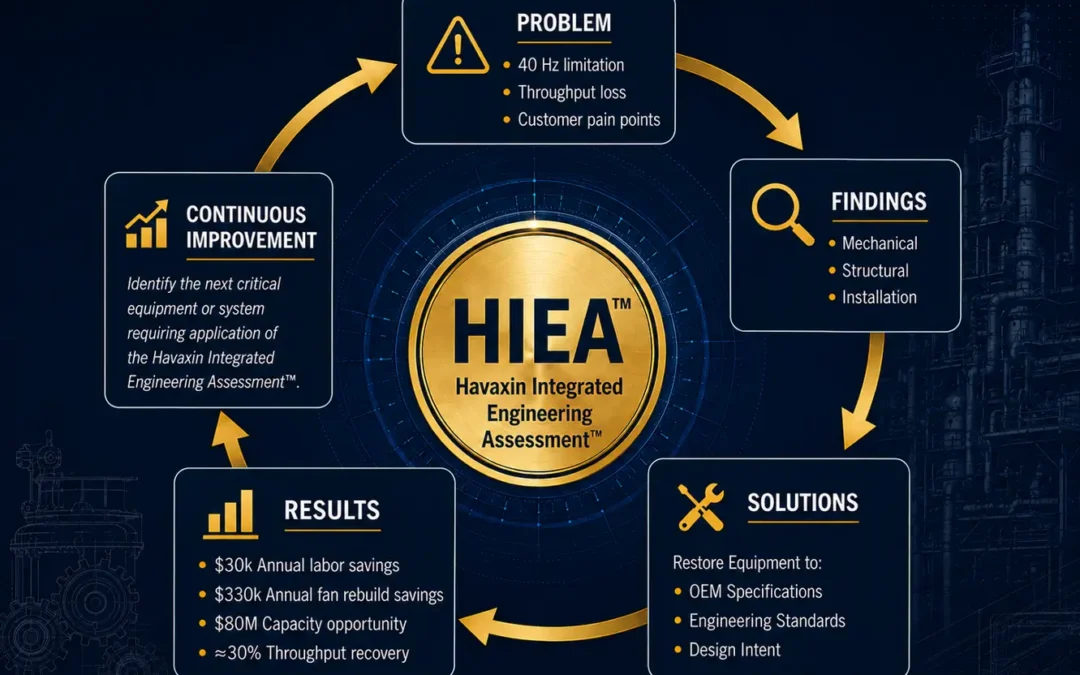
In high‑demand industrial environments, equipment reliability directly impacts throughput, safety, and profitability. Recently, our engineering team completed a comprehensive engineering assessment of multiple homogenizer fans which were designed for 60 Hz operation but consistently failed when pushed beyond 40 Hz. What we discovered not only explained the performance gap — it also highlighted multiple failure points that posed serious operational risks. This article outlines the engineering analysis, the root causes, the corrective actions, and the financial gains achieved by restoring full 60 Hz capability.
Background & Problem Statement
Engineering Assessment Scope
The homogenizer fan is a critical component in maintaining stable process flow and thermal conditions. Despite being specified for 60 Hz, the system repeatedly tripped, vibrated excessively, or shut down when operated above 40 Hz. This limitation reduced system efficiency and created downstream bottlenecks.
- Full mechanical and electrical inspection
- Vibration and modal analysis
- VFD analysis
- Bearing alignment evaluation
- Structural and frame evaluation
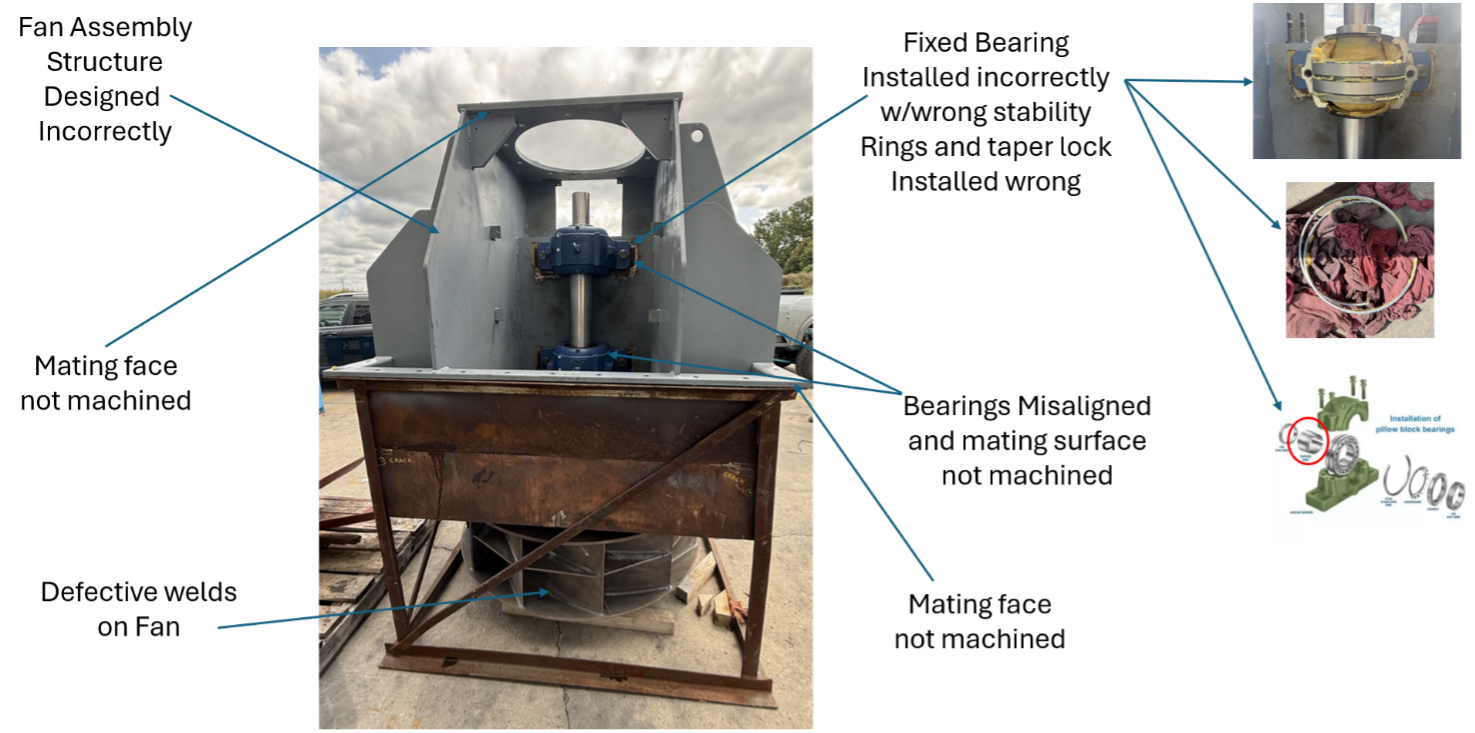
Key Failure Points Identified
LUBRICATION
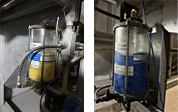
Mismatched and out of spec lubrication
CONTAMINATION
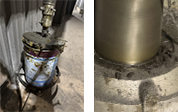
Contamination of lubricant due to improper storage. Containment coming out of bearings.
Mechanical / Structural Issues
- Imbalanced rotor assembly causing amplified vibration at higher frequencies
- Frame resonance occurring near 40 Hz, creating instability
- Misaligned bearings increasing friction and heat load
- Makeshift bearing stabilizing rings made from aluminum instead of using SKF steel stability rings.
- Mounting flange surface not a machined face.
- Bearing mount surface not a machined face.
- Motor mount surface not a machined face.
- Shims for the fixed bearing was not across the entire base of the bearing. It was only in way of the bolt flanges.
- Fixed bearing taperlock was improperly installed.
- Heat slinger not installed on fixed bearing.
- Defective welds on fan blades, size and porosity.
- Shaft out of alignment.
- Fan had inadequate support causing flexing.
- Inadequate welds on fan structure assembly.
- Fan mating face was a structurally inadequate design.
- Lubrication used did not match bearing manufacturer’s specification.
- Incorrect coupling used on shaft.
- Coupling installation incorrect per manufacturer’s specification.
Electrical / Motor Issues
- No electrical/motor issues found during assessment.
Aerodynamic / System-Level Issues
- No aerodynamic / system-level issues found during assessment.
Potential Catastrophic Failure Risks
(If Operated Without Correction)
Bearing seizure leading to sudden shaft lockup
Rotor-to-housing contact resulting in catastrophic mechanical failure
Motor burnout and electrical fire risk
Structural frame cracking or collapse
Complete fan disintegration due to harmonic resonance
Note: aside from the above equipment failures, some failures create projectiles which endanger workforce safety.
Corrective Actions Implemented
Balanced rotor assembly
Aligned bearings
Installed correct bearing stabilizing rings (SKF steel)
Machined mounting flange surface
Machined bearing mount surface.
Machined motor mount surface.
Installed correct shims for the fixed bearing that covers the entire base of the bearing
Reinstalled the fixed bearing taperlock correctly
Installed heat slinger on fixed bearing
Removed defective welds on fan blades and rewelded to specification
Aligned shaft
Installed fan supports
Removed and rewelded fan structure assembly.
Redesigned, fabricated and installed proper mating
Flushed system and replaced all lubrication per bearing manufacturer’s specification.
Installed correct shaft coupling per manufacturer's specifications
Balanced rotor and fan assembly
Redesigned and reinforced structural frame to shift resonance band
Precision bearing realignment and upgraded bearing materials
Electrical harmonics filtering and/or VFD tuning adjustments
RESULTS
Achieving Full 60 Hz Operation
After implementing the corrective actions, the homogenizer fan successfully operated at the full design frequency of 60 Hz, with:
- Reduced vibration levels
- Lower thermal load
- Improved airflow and system efficiency
- Extended equipment lifespan
- Reduction in process cycle time
- Improved homogeneity of product, thus better quality product
FINANCIAL IMPACT & ROI
- Increased throughput: 30% improvement
- Reduced downtime: 240 hrs saved per mo
- Energy efficiency gains: 30% reduction
- Maintenance cost reduction:
Labor = 12hr changeover * 4 people
@ $50/hr * 12 times/year = $28,800
- Fan rebuild cost reduction:
Fan rebuild = $30,000
$30,000 * 12 times/year = $360,000
minus (1 change per year) = $330,000
- Extra capacity opportunity:
720K/day * 340 days = $244,800,000
$244,800,000 * .33 = $80,784,000
Total ROI: ~$81M gained
from restoring full 60 Hz operation
Closing Thoughts
Engineering assessments like this demonstrate the value of deep technical analysis and proactive reliability management. By identifying root causes and implementing targeted improvements, we not only restored the homogenizer fan to its intended performance — we unlocked significant operational and financial benefits for the entire system.
If your organization relies on high‑performance process equipment, investing in a thorough engineering assessment may be one of the most profitable decisions you make. If you are having reliability challenges, contact us, so we can discuss how we can help.
The deterioration/loss of seasoned/expert knowledge is a global issue. It does not have to stay this way. In addition to our team conducting engineering assessments as outlined in this article, we have a 2.0 training service where we create AI agents that both train and continually support as an interactive knowledge base/mentor for your critical or all organizational roles. Ask us about how to ensure you retain/gain institutional expert knowledge for generations to come.